

As LDHR leaders, our role is to build capacity and help accelerate the mission. We may not be the ones carrying out the day-to-day, front-line ministry work. So how do we meaningfully contribute to the mission from where we sit?
One answer to consider is this: by becoming great strategic partners to ministry leaders.
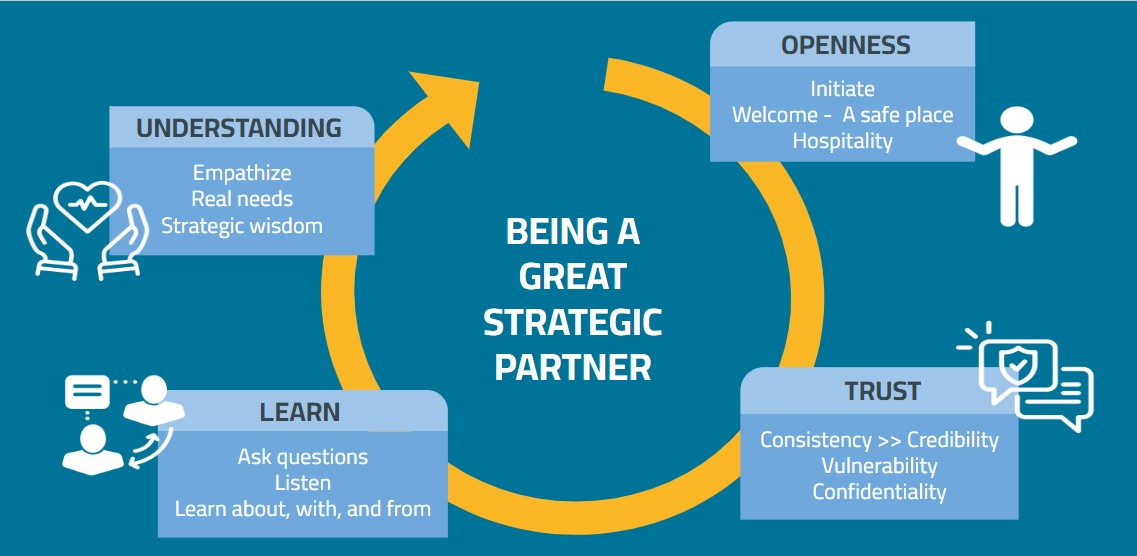
A strategic partner doesn’t simply provide services or processes. Instead, we come alongside leaders to help them think clearly, grow in leadership, and strengthen the teams they lead. I have adapted a framework from Duane Elmer’s book, Cross-Cultural Servanthood, to highlight four qualities that shape healthy partnerships.
1. Openness
Great partnerships begin with openness. As LDHR leaders, we take the initiative to create a welcoming environment where ministry leaders can come as they are.
We do not show up with a club or a clipboard to measure someone’s performance. Instead, we create a safe space for honest conversation. Openness is rooted in the biblical idea of hospitality. Notice the connection to the word hospital—a place where healing happens.
Often, leaders simply need a place where they can speak freely without feeling evaluated. Our tone, posture, and non-verbal cues communicate openness long before our advice does. When leaders sense they are accepted rather than assessed, meaningful conversations can begin.
2. Trust
Trust is the foundation of every strategic partnership.
One important element of trust is confidentiality. A VP, Regional Leader, or National Leader needs to know that what they share with you is safe. When leaders know their conversations will be handled with care and discretion, they are more willing to speak honestly about challenges.
Trust is also built through consistency. When you do what you say you will do—again and again—you demonstrate integrity. Over time, this reliability builds credibility and strengthens the relationship.
Appropriate vulnerability also contributes to trust. When we share honestly about our own growth and learning, it signals that we are partners in the journey, not distant experts.
3. Learn
Once openness and trust are established, people feel safe to share their real needs.
At this point, our role is not to arrive with the right answers. Instead, great strategic partners show up with curiosity. We ask thoughtful questions, listen carefully, and seek to understand the context.
Learn about their team, people, mission, and the challenges they face. But resist the urge to jump in and solve the problem immediately. Instead, learn with them and learn from them. Often, the best insights emerge through powerful questions and thoughtful conversation.
4. Understanding
As you listen and learn, a deeper understanding begins to develop. This understanding allows you to respond with empathy and wisdom.
Continue asking questions with compassionate curiosity. The more you truly understand a leader’s context, pressures, and goals, the more you increase empathy, discover real needs, and can effectively bring long-term, big-picture insights into the conversation.
Over time, this kind of understanding transforms a simple support role into a genuine strategic partnership.
We grow as strategic partners by recognizing where we are—and taking the next step forward.
Reflection
Which of these four elements—openness, trust, learning, or understanding—is your greatest strength?
And which one might be your weakest? How might you grow in this area?
Leave a comment.
What helps you grow as a strategic partner?
 English
  Chinese (China)
  Chinese (Taiwan)
  French
  German
  Japanese
  Korean
  Polish
  Portuguese
  Russian
  Spanish
  Ukrainian
  Arabic
4 thoughts on “Being a Great Strategic Partner”
Steve, thanks for this thoughtful, concise article. I especially loved the line “Great strategic partners show up with curiosity.” I think that’s so true. Powerful questions often help the other person find their own solution or path forward. Great reminder!! Thank you.
Glad it was helpful. Being curious is a good reminder whether you are showing up with others or even with yourself. Instead of curiosity, I find that judging or fixing is the more natural default. Have you noticed that? Any thoughts on why you think that is or how you stay curious?
great points, thanks for sharing this excellent article!
Thanks for stopping by. I am glad you found value in this. Yes, I have made some mistakes over the years trying to figure things out on my own and showing up with a “good” idea. A focus on these principles has helped me to build a relationship with trust and true partnering.