


 IDENTIFYING SOLUTIONS
To address performance issues, it is vital to try to establish the cause of the poor performance and look at addressing it from a developmental rather than disciplinary perspective. Often, by identifying the cause and the staff member’s related need, you can find solutions that help the staff member grow and thrive in their role or on staff without resorting to disciplinary measures. Here are eight needs and solutions that you could explore with the staff member. They are in an intuitive order if you want to work through them, but you may already have a hunch what the issues are from your early conversations with the staff member.
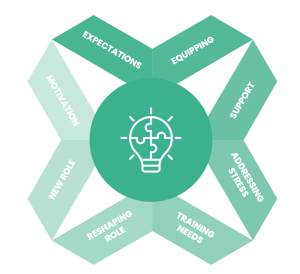
Expectations – As we mentioned in the first section, having clear, articulated expectations is vital. A good starting point is to clarify with the team leader what the expectations are and how they were communicated to the staff member, and to ask the staff member whether they understood them. Beyond clarity, there may also be an issue around whether you and the staff member believe the expectations are achievable or whether the leader has been overly optimistic about what can and should be done.
Equipping – Sometimes what looks like a performance issue is actually a matter of physical, circumstantial, or environmental factors. Does the staff member have the physical equipment they need? Are there financial issues at play? Is their home or ministry environment suitable for the tasks they have been assigned?
Support – It’s a generalisation, but overall, we tend to be great at training and supporting new staff members, but sometimes leave them to figure it out after that. Different personality types need very different types of support to do their role. Using feedback from a personality assessment or a 360 degree review (if shared) can help you see where staff might need particular feedback, coaching, or support to thrive.
Addressing Stress – Sometimes the ‘support’ needed goes deeper than just coaching. A certain level of stress is expected in any ministry or work environment, but identifying when this stress has tipped over the edge and become overwhelming or debilitating is vital to addressing performance issues. Sometimes it’s a season, and sometimes personality factors are at play. Whatever the cause, boundaries for the staff member, a manageable workload, time off, and time with the Lord are important. The staff member may need more expert or professional help in this area.
Training needs – We’ve already touched on the need to have role training in place ahead of transitions, but training needs continue when a staff member is in role. A particular aspect of the role may be unexpected, or a new skill may be required as the role evolves, but continuing to assess and address training needs in our forever-changing ministry environments is increasingly necessary.
Re-shaping – If these five areas have been explored – expectations are clear, they have all they need (physically, intellectually, emotionally), and you have addressed any training needs you can identify – then you need to consider whether there is an aspect of their role that they are just not capable of fulfilling in the long term. In many cases, if the team has capacity or flexibility in how goals are achieved, you may be able to reshape the role to fit the staff member. This often requires creativity and intellectual flexibility, particularly if you have a supervisor who has “always done things this way”! An assessment such as Working Genius can help identify how to shape a role around someone’s ‘genius’.
New Role – Sometimes it is simply not possible to reshape a role, or the performance factor is so central to the role it would not be appropriate. This is where delicate, honest, and grace-filled conversations need to take place to explore possibilities of a new role within the organisation. As an LDHR professional, you need to be aware that legal boundaries may limit what is appropriate to say, even when discussing internal moves. In addition, emotions are may be high, and a staff member’s “fight or flight” response may trigger unexpected reactions. If you believe the conversation will cause the staff member to feel their position on staff is being threatened, please ensure you understand your legal parameters on unfair and constructive dismissal.
Motivation factors – This is probably the trickiest and most nebulous issue to examine, which is why it is most helpfully left until you’ve considered all other factors. Motivation factors fall into a few categories:
- Factors we can address – Is the lack of motivation rooted in an organisational issue that can potentially be addressed? (Relationships with team members or supervisor? Some other aspect of team life? A [maybe flexible] policy or requirement that is tripping them up? A ministry context that is triggering in some way?)
- Factors we can assist with – These may have already been considered earlier in the process, but joining staff can often trigger emotional or spiritual needs that haven’t surfaced before. Professional counseling or other mental health support can often redeem a difficult situation and restore a staff member to health. Alongside emotional health, sometimes they may just need a doctor’s visit!
- Factors we cannot help with – In my experience, the Lord often works within people’s motivation before it impacts their conscious thinking. Sometimes a lack of motivation indicates that the Lord is starting to ‘pull up the tent pegs’ on a person’s time with our movement. As with the conversation around a potential new role, this conversation needs to be carefully managed as a pastoral conversation that explores, rather than a disciplinary conversation that dictates. Make sure you communicate that, at this stage, you’re discussing what the Lord may be saying, rather than discussing a potential dismissal.
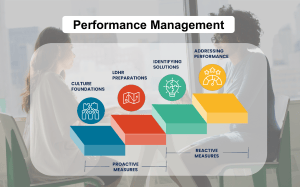
As we mentioned in ‘LDHR Preparations’, it is essential to document all interventions that have been discussed and implemented. It is also helpful to put these things in writing/email to the staff member as mutually agreed-upon interventions. This is NOT the same as a Performance Improvement Plan, as we will now discuss in the next section.
Taken from the document “A Guide to Managing Staff Performance” by Paul Cheseman


 Arabic
 English
 Chinese (China)
 Chinese (Taiwan)
 French
 German
 Japanese
 Korean
 Polish
 Portuguese
 Russian
 Spanish
 Ukrainian